Because I like a sturdy purse I added fusible interfacing to the lining, upper outer band, and handle. Because of the added interfacing on lining (and because I'm lazy) I sewed the lining in by top-stitching only.
The adventures of an amateur crafter and sometimes professional costume designer on Maui - who also happens to work with lasers at a world class observatory.
Monday, January 18, 2010
Buttercup Bag
Because I like a sturdy purse I added fusible interfacing to the lining, upper outer band, and handle. Because of the added interfacing on lining (and because I'm lazy) I sewed the lining in by top-stitching only.
Monday, December 28, 2009
Pete
Pete and I are headed to Egypt. This may be taken literally or it may mean that I’m going crazy, you’ll have to stay tuned to find out.
Pete is my friend Aly’s Choreography Lamb. I made Pete from a free lambkin softie pattern from allsorts. Pete is a “choreography” lamb because he is made from a “choreography” sweater (ie: a sweater worn while choreographing) which had a special meaning to Aly and was used in the creation of Ren’s quilt.
I will try to provide updates on the adventures that Pete and I have based on internet availability during our journey. However, you may just have to wait until we get back to find out what happened.
Thursday, November 19, 2009
Mini-Lonestar
She knew it would be a boy so the blue lonestar would work great. I had planned to have it complete before this past Wednesday because we were going to have a shower for her at work, but she had the baby early, so I had extra time. I finished the quilt tonight, so I think I'll try to visit her this weekend.
For the quilting I stitched-in-the-ditch for the lonestar and used some decorative designs from my Fons and Porter's Quilter's Complete Guide and increased the size to better suit my lonestar.
Sunday, October 11, 2009
Dress for Lexy
For fabric she wanted something yellow or purple with a pattern so I bought this fabric from fabric.com:

I also had to buy elastic thread (couldn't find it on the island) and unfortunately the 11 yd spool from fabric.com wasn't quite enough so I had to get this instead:
To use elastic thread you need to hand wind it on a bobbin, being careful not to stretch it while winding. Like some decorative metallic threads the elastic thread is too thick to thread through a sewing machine and needle, so instead it goes on the bobbin.
When shirring the top (making the rows of elastic to gather the top) you sew rows from the right side (as opposed to the wrong side) of the completed dress in a continuous line that circles around the bodice for about 6-8" down from the top of the dress. The elastic ends up on the inside of the dress and the tension from the top thread helps to gather the fabric. You line of the edge of the presser foot with the previous row to keep them parallel and it's very important to pull the fabric flat while sewing.
One problem I had was that the amount of elastic thread that can be wound on a bobbin is not enough to complete the top. It took about 3 bobbins and when one ran out I'd just overlap the beginning of the next bobbin over the end of the last.
I shortened the pattern from Heather Ross significantly and according to Lexy it is still too long for her, so I'll have to shorten it when she is home for Christmas. Here's Lexy in the dress:
Sunday, October 4, 2009
Shopping Tote
The biggest annoyance are plastic bags. If you've ever driven past the central Maui landfill you know what a problem throwing them out can be. I quit my Masters program in Environmental Policy and Management because I'm not enough of an environmental nut to care that much, but plastic bags seem excessively wasteful even to me.
Needless to say I was thrilled when reusable bags started popping up all over Maui. My favorites were from Star Market, because they folded up nicely:
Unfortunately the recycled material they were made wasn't exceptionally strong and the handles started ripping. So, I decided to use the bags I had as a pattern and made my own. Here's how!
What you'll need:
1/2 yard of heavy-weight fabric 60" width
1" of velcro
1 1/2 yards of 1/4" double fold bias tape*
Cutting:
Fold the fabric in half to cut the following:
1 Rectangle 33" x 16.5"
2 Strips 17" x 2.5"
1 Rectangle 7.5" x 11.5" (one end will be rounded off)

The handles are folded in half, right-sides together and sewn with 1/4" seam and turned right side out. I over-stitched the edge with the seam to help the handles keep their shape.
After rounding one end of the pocket as shown below, cover the edge of the pocket all the way around with the double fold bias tape (*I'll discuss an alternative at the end). Sew the velcro in place (the fuzzy side is sewn on the outside of the pocket, 2" from the top edge, the pokey side is sewn on the under side of the flap).

The rounded edge of the pocket will end up as a flap. When you sew the pocket to the bag, the bottom seam will be 8" from the top (the dashed line in the drawing), not along the curved edge. Sew the pocket to the bag 4 3/4" from the top edge of the bag and 3 3/4" from the fold that creates the bottom of the bag.
The handles are sewn at each end with each side of the handle 2 1/4" from the center. The edges of the handles will line up with the top edges of the bag. When the top is hemmed the handles will stand up.

Fold the bag in half, right sides together and sew edges together. Finish by hemming the top of the bag under by about 1". Topstitch as close as possible to the top edge of the bag to secure the handles. Finally, fold up, pressing as you go to establish the folds for future use.
*Some notes and suggestions.
Instead of using bias tape around the pocket you could line the pocket by cutting two of the pockets (there will be enough fabric in your 1/2 yard) and sewing them right sides together along the long sides and curved end and then turning right side out and folding under the top. When cutting, you'd need to add at least a 1/4 inch all around the pocket for seams.
Also, if you want you can line the bag. You'd need an additional 1/2 yard of lining fabric from which you'd cut an extra bag piece (you wouldn't need to do extra handles, and if you want to line the pocket, as above, you could do so from either the outer fabric or the lining fabric). You'd sew the two bags separately (the lining would be sewn with the right side in), and place the inner bag in the outer bag before hemming and hem the outer bag over the inner bag (the inner bag should be about 1" shorter than the outer bag).
Wednesday, September 16, 2009
Waffle Week
So, instead of being crafty myself I will share a story of someone else's craftiness that involves two things I love: waffles and the University of Oregon.
Bill Bowerman was the track coach at the University of Oregon in the 1960's and coached the infamous Steve Prefontaine. Bill Bowerman also went on to co-found Nike with Phil Knight, a University of Oregon alum and former runner. Knight worked the business side while Bowerman experimented with Shoe design.

While coaching for Oregon he learned to cobble and custom made shoes for his runners. In order to create a lighter shoe Bowerman did some waffle inspired crafting.
Bowerman and his wife often ate waffles for breakfast - not an unusual or special event for them. Yet one morning, while thinking about his shoe designs and eating waffles, Bowerman had a flash of inspiration. He ran into the garage with the waffle iron and poured rubber on it. With that one idea Bill created Nike's now famous waffle soul. As it turned out, when place on a lightweight shoe, the waffle sole gripped running tracks better than the established ripple soul. It soon became a major success story.
So that is how waffles changed sports forever!
Hooray waffles!
Friday, September 4, 2009
Another Old Post from MySpace
Sunday, June 10, 2007
Well, yesterday I also happened to be shopping for costume stuff, so I was in the fabric section and thought, I should have made a little quilt. I made one recently four Lexy's graduation...it took me four years. But I thought if I simplified things I could do it in one day. So I bought some fabric and headed home.
I simplified things by doing absolutely no piecing. I made a sandwich of pink and white fabric (with batting as the bologna) and all the exciting stuff went into the quilting part.
And it worked! In less than 24 hours I had made a quilt. Granted it would have been a lot nicer if I'd had more time, but there wasn't much more time then the time I did it in anyway.
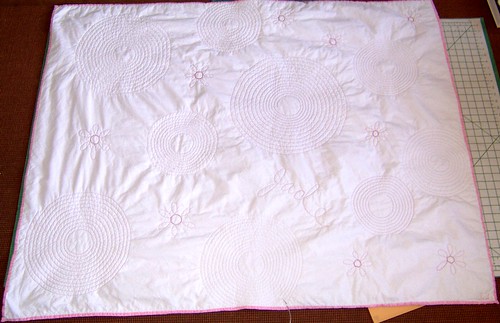
So here are some pictures of the quilt (front and back):


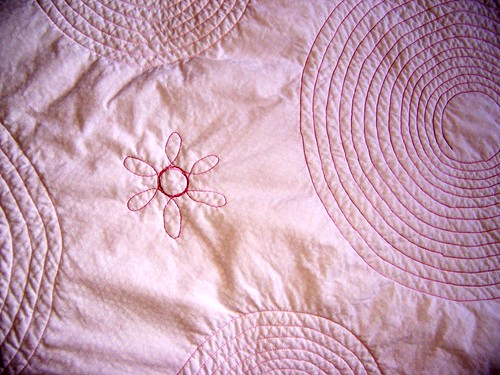
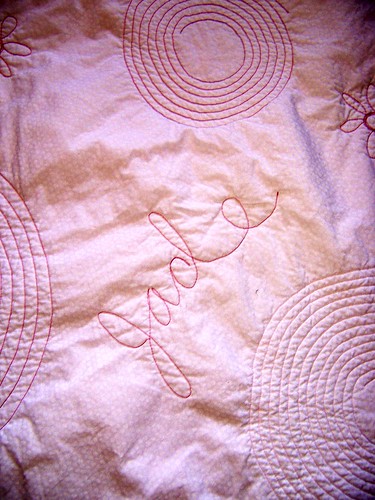
And some detail because it's hard to see stuff above: